Showing posts with label Thelma Lee Gross. Show all posts

Monday, September 12, 2011

The Pink Ride (Guest Post by Thelma Lee)


Intro by Marzie

This blog is run by an atheist. Yeah, that's right, I'm an avowed atheist. And yet I follow the Dalai Lama on Twitter. Why? I like the guy and some of what he espouses. The fact that he's espousing compassion from a religious vantage point doesn't bother me. I believe in compassion. I believe, if not in karma, that what goes around often comes around and that it's better to be good-hearted and honest and compassionate. Because, like HHDL says, it makes me feel better and live in a better world by being part of making it better. And thus, I am willing to risk drawing further ire by not being afraid to say I'm an atheist who likes John Halcyon Styn. He may seem all new-agey with a Christian tinge and over the top, but I like what he says about love and hugs. And I love what he has to say about fear and self-loathing and what a waste it is. I like the fact that he wants to make people feel good and that he rejects hate, rigid gender identity and seemingly a lot of stuff that when you come right down to it, seems always to go back to a position of fear. Fear of the different, fear of the other, fear, fear, fear. To those fears, the fearless man with pink hair offers hugs. And thus, this atheist blogger gives you Thelma Lee's adventures in the desert, with the pink-haired grandson of a Baptist minister (who called himself near the end of his life a "Baptist Buddhist" and said that current religious definitions no longer defined him). John Halcyon Styn has taken it all one step further than that and colored it all pink to boot. He is the author of a book titled Love More, Fear Less. I haven't read the book, but it seems like a great motto to try to live by.


This is a great post to follow the lingering sadness, anger and loss from 9/11. Our world needs more John Halcyon Styns and fewer Osamas and his ilk.


Pink Heart Camp at Burning Man 2011 (© Thelma Lee Gross)

The Pink Ride


A few weeks ago I was reading “The Jackrabbit Speaks,” which is the Burning Man E -newsletter. This is something I only do as the event approaches, being too lazy or unfocused to do so much more in advance.  I suddenly saw the following:

“Halcyon is leading his annual PINK RIDE on Thursday at noon.
Meet @ noon at Pink Heart (9:30 & Esplanade).
Wear pink; bring your bike and an open heart.
Details, video & pics from previous rides:
http://www.hugnation.com/burningman/

PINK?  WOW.  I love pink!  It would be so pretty…WOW, a PINK line of bicycles on the Playa, everyone in PINK.  A visual gift to Black Rock City! And I already have a PINK costume!  

I looked at a few of the photos from the previous ride, but I really didn’t investigate, not wanting to preview details of the 2011 Burning Man festival. (I deliberately didn’t look at the art projects online, for example, and was only accidentally told about the Trojan horse by a friend.)


The Burning Man Illuminated at Night (© Thelma Lee Gross)


What is Burning Man? It is an annual, weeklong event united by a sense of community, self reliance, gifting, and personal involvement in the human canvas that is Black Rock City.  The City is composed of curved, concentric streets that partially encompass the central Playa, where most of the art installations, as well as the Man, are found.  Participation is through performance as well as radical self expression via costumes or absence thereof.  Events, objects, food and drink, music and other performances, classes, clothing: all are gifted unconditionally from the wildly eclectic camps that serve as mini-communities throughout Black Rock City. The city, which this year contained over 53 thousand people, disappears without a trace within two or three weeks, fulfilling another of the central principles:  “leave no trace.” Many structures are burned, including the temple, the Man, and other wooden art installations.  Immediacy is critical; nowhere else on earth (except perhaps India) have I felt so much “in the moment.” For me, Burning Man is an opportunity to be in a continuous brightly colored, interactive dream while being allowed to remain awake.  It is literally one of the most exotic places on the planet.


The Burning Man (©Michael Holden for Burning Man 2011)


On the day of the ride Pink Heart Camp did not disappoint.  There it was, right on the esplanade along the Playa, looking so very pink!  So pretty, pink and furry!


Pink Heart Location at Burning Man 2011
(© Hug Nation)


I took photos of the other pink people and then lounged on a fluffy pink couch waiting for something to happen.  Suddenly there was a slender man, dressed in black with pink hair and sitting before us, the obvious leader. He announced that we were going to wait while a large group joined us.  Waiting….I looked at my watch thinking, “We are leaving late.”  My anxiety over scheduling seemed out of harmony in the desert but personality is a hard thing to shake.  He started to talk and I thought “Okay, he’s just stalling while we wait, okay, just let it go.  Let him talk; it’s his camp and his ride. Just relax and soon you will be on your pretty pink ride, creating a pink stripe on the desert.” 


 Which is all I wanted, wasn’t it?

He started to talk about his grandfather Caleb, a Baptist minister with endless buoyancy and love for people, who died in 2007 at age 95, and their special and loving relationship. Suddenly I realized I was in the presence of a gifted storyteller and preacher, blessed by a perception and analysis of life that was untainted by truisms, platitudes, or an obsession with God. (He does not believe in heaven.)  He began to speak about optimism and joy in life, inspired by his grandpa’s example, and the choice we all have to live in deep appreciation of each moment, one by one.  He talked about the balance life offers between the “ice cream cone in your hand and the crap on your shoes” and how dwelling on the shoes is like Shakespeare’s coward’s “a thousand deaths,” which he sees as a useless suffering over obstacles and possible outcomes, and the obsessive focus on “what ifs” instead of a commitment to the task at hand.  And he spoke of spreading joy and love to other human beings, which he does both actually and emblematically through Hug Nation, a movement he co-founded with his grandfather. 


John Halcyon Styn (© Mike Hedge)


John Halcyon Styn is forty years old.  His personal mantra is love more, fear less; float more, steer less.” John has worked in online publishing and E-commerce as well as in public media.  He has had a varied and intense lifestyle.  Burning Man is the core of his spiritual life. From his website [pronouns changed]:

He does not consider himself a Christian, but does consider Jesus to be one of his valued teachers.   He considers Buddha, Gandhi, Eckart Tolle, Mr. Rogers and many others to be valuable teachers, too.  He believes that a spiritual path is deeply personal. And whatever works for you is perfect. He distrusts anyone who knows ‘the true way’.”

© 
John does a weekly “Belief Buffet” broadcast before Hug Nation each week where he shares “ways that work for him”.  Over the past four years he has spoken about gender labeling (“pink toenails”  or see Bright Nepenthe's post here); relationships; the meaning of death;  the significance of money and abundance; the importance of living in the moment; and the problem of terrorism and war, among other diverse topics.  His opinions and perceptions are balanced, good natured, self-effacing, and just plain smart.  How do I know?  Because I have been watching his on line video blog since I returned from the Playa, and consider him a source of focused and positive energy that has been lacking in my life for longer than I care to admit.
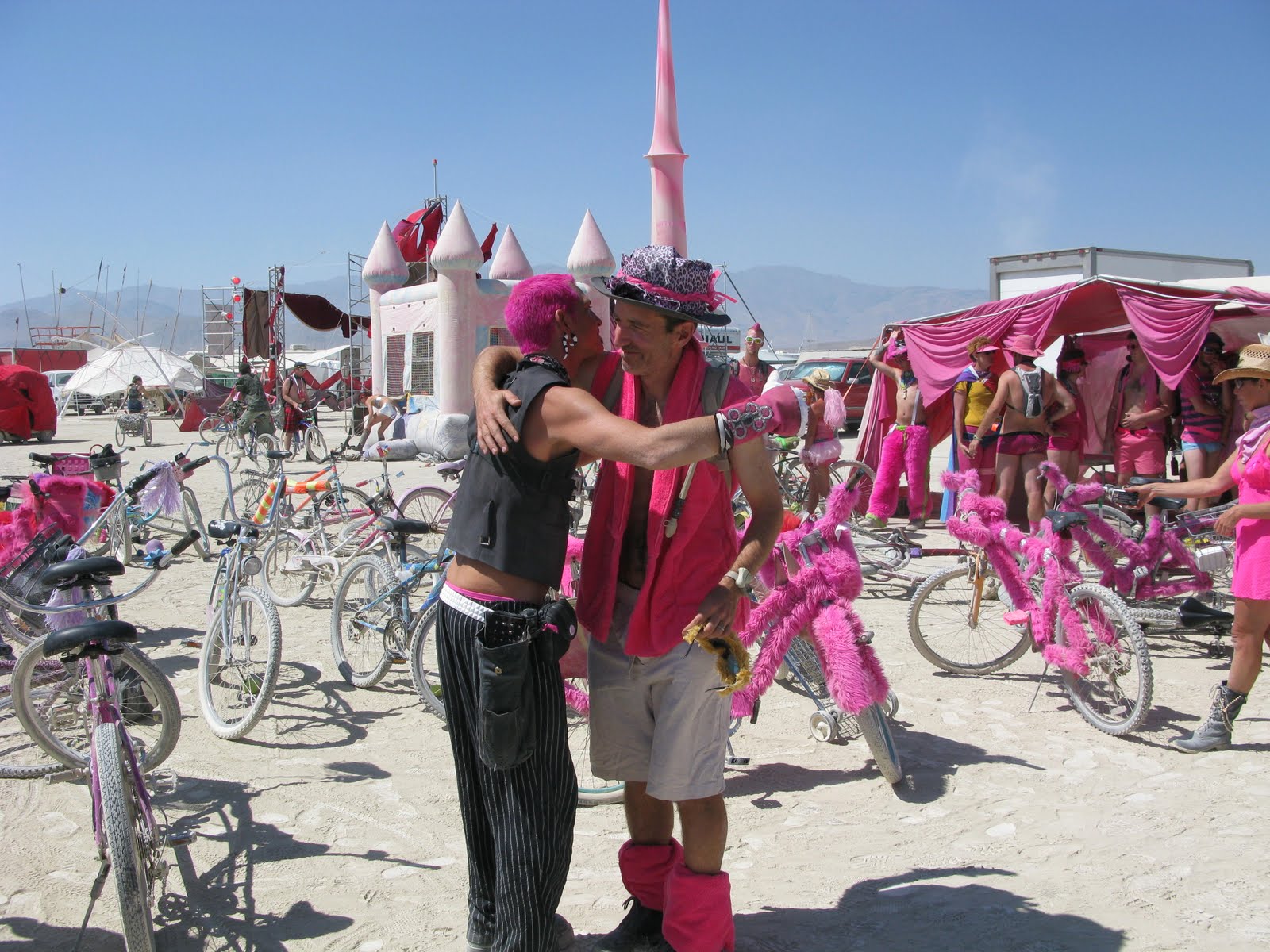


Hugs (© Thelma Lee Gross)

After his talk at the camp, he hugged every single attendee with warmth, for he lives by his word. We then rode across the desert, but the aesthetics of the pink line seemed unimportant now.  Instead we were spreading compliments and smiles with other Burners as we rode.  We ended up in a huge, hand-linked, pink spiral in the middle of Central Camp where we then hugged in rampant, pink, extroverted joy.  And cosmically, if such a thing exists, suddenly there was my husband hugging me too, somehow having showed up at the moment of this supremely happy and yes, pink moment.


I came for the color and I stayed for the message. 


Text and selected images (as noted) copyright, Thelma Lee Gross.


All other content is © Bright Nepenthe, 2011 unless otherwise noted.

Friday, October 22, 2010

Eating Animals, Part 3


Eating Animals is a three part series by Thelma Lee Gross, DVM. What are our options? is the the third and final article. 

Eating Animals, Part 3: What Are Our Options?

In the first two posts I outlined the problems of factory farming systems as they relate to animal welfare and discussed the practical and moral reasons for change.  Vegetarianism and veganism provide only partial and impractical solutions, largely because they do not provide a rapid enough correction.  What else can be done?


Dairy Cow
Image credit: Lisa Kyle for the Los Angeles Times


Organic farming 

The USDA has established guidelines for organic food in the National Organic Program (NOP) that were implemented in 2002. As some of these guidelines deal with behavioral needs of the farm animal, including outdoor access, and there is third party oversight by the USDA, organic farming offers improved welfare over conventional systems, particularly for pork and eggs.  (Farrowing crates and battery cages are not used.)  However, there are some loopholes in the guidelines.  There are several exceptions to allowing outdoor access for ruminants, notably “inclement weather,” which in parts of the Midwest may stretch over many months.  Organic beef also may be fed in feedlots for fattening toward the end of their lives.

It may be difficult to detect substantial differences in welfare as organic farms increase in size.  In a discussion of large-scale organic farming Michael Pollan writes in The Omnivore’s Dilemma (p. 161): 
“The industrial values of specialization, economies of scale, and mechanization wind up crowding out ecological values such as diversity, complexity, and symbiosis.”  
Nevertheless, the organic movement is certainly in a welfare-positive direction, and should be encouraged and promoted on small and large farms alike.  Obviously, welfare improvement on larger farms is critical because it impacts a larger number of animals.

One problem with organic farming, in my view, is the inability of the farmer to administer antibiotics.  Although the USDA forbids withholding necessary treatment for sick animals under Section 205.238 of its NOP code, in practice, farmers often withhold treatment because it is impractical.  Treating sick animals with antibiotics sometimes is avoided since it involves separate housing and handling of the animal, as reported recently in The Des Moines Register. Similarly, organic dairy cows with foot abscesses, a common problem, cannot be treated with antibiotics and kept as organic.  Treatment may be withheld if lameness is not severe enough to affect production, or the animal may be destroyed.  For this reason it seems preferable to purchase from a company with both organic and conventional farms; sick animals from organic farms can be shuffled to the conventional side if treatment is needed. 


Image credit: Sustainable Grub


A practical approach to research in farm animal welfare: the Farm Animal Initiative

Instead of adopting the anthropomorphic approach of some animal rights groups, it is important to discover what an animal actually desires if given a clear choice and to adapt those choices to a practical farm setting.  These welfare needs are species-specific and require research to discover and implement.  For example, laying hens will learn to push a heavily weighted door to be able to dust-bathe and perch. However, an outdoor environment is not something that chickens will invariably seek, being naturally avoidant of inconvenient weather (“weather weenies” as one animal welfare scientist of my acquaintance puts it).  In fact, laying hens often choose to be in shelters but must have access to other welfare enhancements such as litter for dust-bathing, nest boxes, and perches (“furnishings”).  Chickens raised indoors for the first five weeks will often not venture out of doors into grassy areas when they are provided.  Thus “free range” may be more of a marketing tool than a real enhancement for poultry. 

The Farm Animal Initiative (FAI) in the U.K. tests animal welfare-enhanced systems on their for-profit farm, using field research in a commercial setting, and with industry backing (including TESCO and McDonalds Europe). This approach keeps practical issues for the farmer, such as ease of management and economic feasibility, on the table from the beginning.  As described in The Future of Animal Farming, the FAI studies welfare systems that can be adapted to economies of scale.  The FAI farm has studied environmental enrichment for pigs in group systems in which aggression is minimized and therefore tail docking is not needed.  They have found that tree-enrichment of pastures for broiler chickens attracts more birds outdoors without increasing exposure to bacterial disease (although birds still avoid extreme weather).  The farm’s breeding program also selects for animal welfare-enhancing traits in balance with production traits; e.g. broiler birds with slightly smaller breasts and lower-maintenance sheep that can lamb successfully outdoors in all weather.  The FAI farm always emphasizes cost-effectiveness of implementation by the farmer, thus ensuring long term success.  Such practical, farm-based programs as these are sorely needed in the U.S. and could be funded by industry and animal welfare groups alike. 


Image attribution unknown


Third party inspection and certification programs

An important way to avoid marketing as a substitute for committed improvement of farm animal welfare involves third party independent inspection and certification programs.  Several such systems exist in the U.S. and abroad.  In 2000 the American Humane Association established Free Farmed Certification (now called American Humane Certification). I was unable to find a description of their standards online; access appeared to be restricted to prospective or active producer-members.  This organization is currently being criticized for its support of furnished cages (cages with nests, perches, and scratching areas, as well as more space per bird).  Nevertheless, these certified farms practice a higher level of welfare than conventional factory farms.

In 2003 the Human Farm Animal Care organization was formed, which certifies products that have been reared according to its strict guidelines (“Certified Humane”).  Their standards are clearly presented online for the consumer and producer and are considered by some groups as the “gold standard” of its type. These standards can be adopted by large farms. 

The Animal Welfare Approved (AWA) program was begun in 2006.  Standards are the most stringent of the three programs; however, only farms owned by individuals or families are accepted for certification, which largely restricts membership to small farms.  Although the standards are laudable, it is also critical for large farms to improve their welfare standards in order to affect the greatest number of animals possible.  Moderate, incremental improvements are more easily accepted by large producers.

As consumers we can send a clear message to retailers, and thus indirectly to producers, that there is a demand for animals that are raised as animals and not widgets.  Consumers are the ultimate supporters of welfare improvements because increased demand in the marketplace sends a strong message to the retailer, which drives demand for these products back up the line to the farmer.  This explains TESCO’s support of FAI in the U.K., for example.  If we are serious about animal welfare, then we must strive to eat humanely by purchasing food for which production is welfare-driven.  Increased cost is often less than anticipated, and seems a fair price to pay to the farmers who are willing to make these changes in their production methods.  

Steady advancement in food animal welfare, occurring in the setting of persistent food animal product consumption, may be in conflict with more aggressive groups such as PETA, rejected by many due to positions and actions that are deemed extreme, despite their laudable goals.  On the other end of the spectrum of animal welfare consciousness, increased cost of organic and other higher welfare products often is at odds with a fast-food nation mentality.  Many people say one thing but pay another.  But there are signs that the consumer is coming along.  In 2009 voters in California passed Proposition 2, which required all farm animals to be able to stand up, turn around, and stretch their limbs, thereby curtailing the use of swine gestation and farrowing crates, as well as battery cages for laying hens.  Governor Arnold Schwarzenegger later closed the loophole for egg producers by requiring all out-of-state eggs to be held to the same housing requirement. 

The only practical and humane solution is to consume fewer animal products and to be sure they are produced as humanely as possible.  This is not a perfect solution—but neither is trying to feed everyone on grains and legumes.  Actively influencing others to consume less and make better welfare choices, as advocated by Michael Pollan, may be the most practical and timely option we have.  Try to purchase products that are third party certified, or, at the very least, organic.  Factory-farmed meat and other products should be shunned, including eggs and milk.

If we, as moral beings, eat animals and their products or live in a world where others do, then we must strive for animal welfare systems that give them more of what they want.  In other words, we must honor them with as good a life as possible, even if we personally do not eat them. 


Thelma Lee and I will be doing a question and answer discussion about some of the issues that she has written about in this series. If you would like to add your question to the list, email me at marzie.blogs@gmail.com.

The main text portion of this post is ©Thelma Lee Gross, 2010.

All other components are by Bright Nepenthe, 2010


© Bright Nepenthe, 2010

Wednesday, October 20, 2010

Eating Animals, Part 2


Eating Animals is a three part series by Thelma Lee Gross, DVM. Food for Thought is the second of three parts. 


Eating Animals, Part 2: Food for Thought

In the previous post I addressed the problem of factory farming and the welfare issues it creates.  In response to the overwhelming weight of the problem and its seeming insolubility, many of us have chosen to reduce or eliminate our consumption of animal products.  But is this the most moral choice?  Is it the most practical one?


Image Credit: NIH/National Library of Medicine

The problems of vegetarianism

Vegetarianism tends to ignore the barbaric conditions of most conventional egg and milk producing operations in the country today.  In truth, a strong argument could be made for the intrinsic inhumanity of any milk or egg producing system, no matter how welfare-oriented.  Male chicks are destroyed as hatchlings; on conventional factory farms, egg-laying hens are crowded into battery cages.  Even the Human Farm Animal Care Association permits slight beak trimming on its certified farms.  Male newborn dairy calves are removed from their mothers, and are destroyed or siphoned off into baby beef or veal production.  Cows have been bred into walking udders that are milked three times a day, and are always eating in an attempt to keep up with such a huge caloric demand.  Thus, a vegetarian must consider sourcing eggs and milk from welfare-intense systems to be eating humanely. 


Image credit: GoingVeggie.com

The problems of veganism

TThe clearest ethical argument is that killing animals for food is wrong, no matter how they are raised.  From the point of view of the individual, how can this be an arguable position?  However, seen from the point of view of our species as a whole, it becomes less clearcut, less black and white.  Certainly, there are evolutionary reasons that we eat meat; losing our dependence on fibrous leaves and switching to meat may have coincided with the weakening of our jaw muscles, allowing our skulls to expand and our brains to enlarge. (To learn more about this concept, see here.) It is ironic that meat consumption may be coupled to the development of brains that are big and complex enough to consider the ethical problem of eating meat! 

Should we override our omnivorous genetic imperative?  Or are there are other reasons besides evolution to justify the consumption of animal products in a morally conscious modern society? 

Certainly health concerns surrounding veganism abound in the literature.  But, even if every vegan could manage a healthy diet, a totally vegan world is not a viable solution.  Healthy veganism simply is not attainable in third world countries where sources of grains may be limited due to inhospitable soil or climate.  One hopeful opportunity to reduce our dependence in the future is synthetic meat production, such as the recent creation at the University of Missouri of a soy chicken that not only tastes like poultry meat, but has a similar texture.  The practical employment of universally available, palatable meat alternatives unfortunately is still years away.

Grain production is not a kill-free proposition.  Steven Davis from Oregon State University makes a convincing argument that consumption of grassfed ruminants will result in fewer animal deaths than veganism, which requires a heavier diet of grain. As fields are turned over during planting and harvesting, nests of small mammals, such as field mice, are disrupted and babies destroyed.  The counterargument is that death from grain production is accidental, whereas animals reared for food are deliberately killed. 

Lastly, vegetarianism and veganism are also unlikely to be adopted by a majority and thus are slow and ineffective ways to bring about change in food animal welfare.  A recent survey conducted by a Harris Poll for Vegetarian Times in 2008 showed that “3.2 percent of U.S. adults, or 7.3 million people, follow a vegetarian-based diet.  Approximately 0.5 percent, or 1 million, of those are vegans, who consume no animal products at all.”  A personal choice to become a vegan certainly gets one off the ethical “hook” but it does not address the fact that most of the world will never be vegan, at least not for generations to come.  We must seek a faster solution.  We must consider the right of all food animals to a decent life.  This is as much a moral imperative as is the avoidance of consumption.


Next:  What are our options?


The main text portion of this post is ©Thelma Lee Gross, 2010.

All other components are by Bright Nepenthe, 2010

Monday, October 18, 2010

Eating Animals, Part 1


Thelma Lee Gross, DVM, is a regular contributor to Bright Nepenthe. This week she is sharing her thoughts on humane farming in a three part series, Eating Animals.


The Butcher Shop
Attribution unknown


Eating Animals, Part 1

When humans were hunter-gatherers and food production was the business of small farms and family units, the concept of animal ethics was moot: if you didn’t care for your animals humanely, you would not survive.  In the modern world, productivity has become separated from welfare.  This is because we have found ways to keep animals healthy enough to produce without also considering, as Marian Stamp Dawkins says simply in the superb book, The Future of Animal Farming,  “what animals want.”  Technology and science have allowed us to raise animals in an industrial setting that does not necessarily consider the need for a decent life, which includes positive aspects like fulfillment of natural behavior, but also avoidance of negative factors, such as stress, boredom, and fear.  

The problem of factory farming

In The Omnivore’s Dilemma (p. 318), Michael Pollan states that 

“…..tension has always existed between the capitalist imperative to maximize efficiency……..and the moral imperatives of culture…. [There is a] tendency over time for the economic impulse to erode the moral underpinnings of society.  Mercy towards animals in our care is one such casualty.” 

The industrialization of food animal production has eroded our mercy towards the creatures that supply our food.  We buy it neatly packaged in the supermarket and look the other way.  High demand for food animal products in wealthy and emerging countries is accentuated by the steady force of increasing population.  With the economies of scale at work, farms have become larger and the individual attention to animals has weakened.  Animals are raised in denser populations to maximize the number per unit of human labor.  This decreases the opportunity that the farmer has to know individuals, while emphasizing the herd approach.  Even at the level of the farm, therefore, food production has become impersonal.

 The “healthy” closely confined, productive, factory-farmed animal is often achieved only by grace of the recurrent administration of antibiotics, without which closely confined animals cannot survive exposure to disease.  This intense confinement may result in the need for preventative surgical intervention (tail docking in pigs, beak trimming in poultry), as well as the loss of natural behavior.  This leads to boredom, stress, stereotypic behavior (snout nesting movements in crate-confined sows), pain (from confinement-related injury or surgical procedures), and fear.


The problem of the American Veterinary Medical Association

Farmers are a vital and industrious part of our community who care deeply about feeding their nation and often the world.  So why don’t farmers care more about animal welfare?  In essence they do, but by a narrow definition.  Many farmers, particularly those who are involved in the larger operations of industrial food production, believe that if the animal has good physical growth and/or production, and an absence of organic disease, then their welfare is good.  This ignores or subjugates the behavioral choices an animal might make in an optimal environment in which it would be free to decide what it would like to do.  Stress from confinement and the impedance of desired and natural behaviors are simply overlooked because they are not believed to negatively impact profit, and because the animal is not overtly ill.  Animals don’t have to be content and fulfilled, just healthy and productive in this model. 

Motivational studies can reveal what natural behaviors are most important to each species of animal we raise for food and these can be incorporated into new and more humane systems of animal production and housing.  However, there are seemingly persistent health, safety, and economic arguments against the alteration of current systems of factory farming.  These are promulgated by groups that believe that natural behavior and animal contentment are not more important than production, physical health, and food safety.  This was underscored in the 2005 AVMA Welfare Forum: Sow Housing and Welfare, in which the industry, animal scientists, and animal welfare representatives met to discuss the current highly confined system.  The AVMA unfortunately concluded that no current system was better than any other for housing sows.  They stated that their assessment (indicated as a “revision” of policy) was based “...on consideration of animal welfare as assessed through the scientific literature and professional judgment and experience.” 

In the recent Pew Commission’s 2008 report on Industrial Farm Animal Production,  the commission stated that “good animal welfare can no longer be assumed based only on productivity or absence of disease.”  They cited battery cages for hens; gestational and farrowing crates for sows; and crates or tied confinement for veal as the most glaring examples of inhumane practices in factory farm settings.  The American Veterinary Medical Association subsequently published a response to the report,  in which they diminished the findings of Pew by criticizing the commission’s emphasis on confinement housing.  They stated:  

“In fact, simply increasing the space allotted to animals will always have both positive and negative effects…..Furthermore, increasing space while maintaining a barren environment is unlikely to substantively satisfy an animal’s behavioral needs.”

The Pew Report had not concluded that space changes should be made in a void, or that the environment should be “barren.”  In fact, the commission cited the European Union’s animal welfare program that calls for several basic categories of farm animal welfare: optimal feeding, comfortable housing, a good thermal environment, freedom to move, health systems that prevent injury, and the means to allow expression of non harmful social behavior.  In the sow housing welfare forum, mentioned above, Dr. Harold Gonyou of the Prairie Swine Centre of Saskatoon indicated that there were at least 72 possible combinations of sow group housing systems to consider, certainly not an either-or proposition.  Although the AVMA was careful to point out that intensive systems support health while extensive systems support behavior, and that it is erroneous to focus exclusively on only one these factors, they further stated: 

“People, including veterinarians and other scientists, approach animal welfare from different viewpoints and attribute various degrees of importance to different measures of animal welfare on the basis of their education, training, experience, and personal values and the perspectives, morals, and ethical constructs of the society in which they live and work. The Pew report, like all assessments of farmed animal production systems, reflects its authors’ views and prejudices.” 

By categorizing the effort to improve farm animal welfare as a “viewpoint” or “prejudice”, the AVMA fails in one of its duties to animals as outlined in the Veterinarian’s Oath: the relief of animal suffering.  The organization has an allegiance to the food animal industry, which includes food animal veterinarians and animal scientists.  But their caution at a time when bold leadership and action are needed is shocking, particularly in the context of increased public awareness of the AVMA’s weak position on animal welfare. (See the full page advertisement in the New York Times.)

Caulfield and Cambridge of Animals Australia take this science-based welfare approach to task eloquently in their 2008 article in the Australian Veterinary Journal.  They question why scientific method must always trump moral and ethical considerations in the rearing of our food animals and why the status quo must always be maintained until there is irrefutable scientific evidence; in other words, they question the position of organizations like the AVMA. If classical scientific method is not allowing us to rapidly improving welfare, then we must broaden our approach and escape such a “reductionist” position.  As an example of scientific obfuscation on the subject of animal welfare, an article in 2002 Journal of Animal Science  proposes a model that “contains 37 attributes that describe the welfare-relevant properties of housing and management systems….these attributes are linked to scientific statements and a list of needs to provide a scientific basis for welfare assessment.”  Animal scientists and others in the industry speak of “perceived” welfare, as if human beings cannot determine a clearly ethical way of raising an animal by their own observations and the use common sense.  The Farm Animal Initiative in the U.K. has implemented such practical systems of investigation of farm animal welfare, and will be discussed further in the final part of this series.


Next:  Why avoiding farm animal products is not a global solution.


The main text portion of this post is ©Thelma Lee Gross, 2010.


All other components are by Bright Nepenthe, 2010